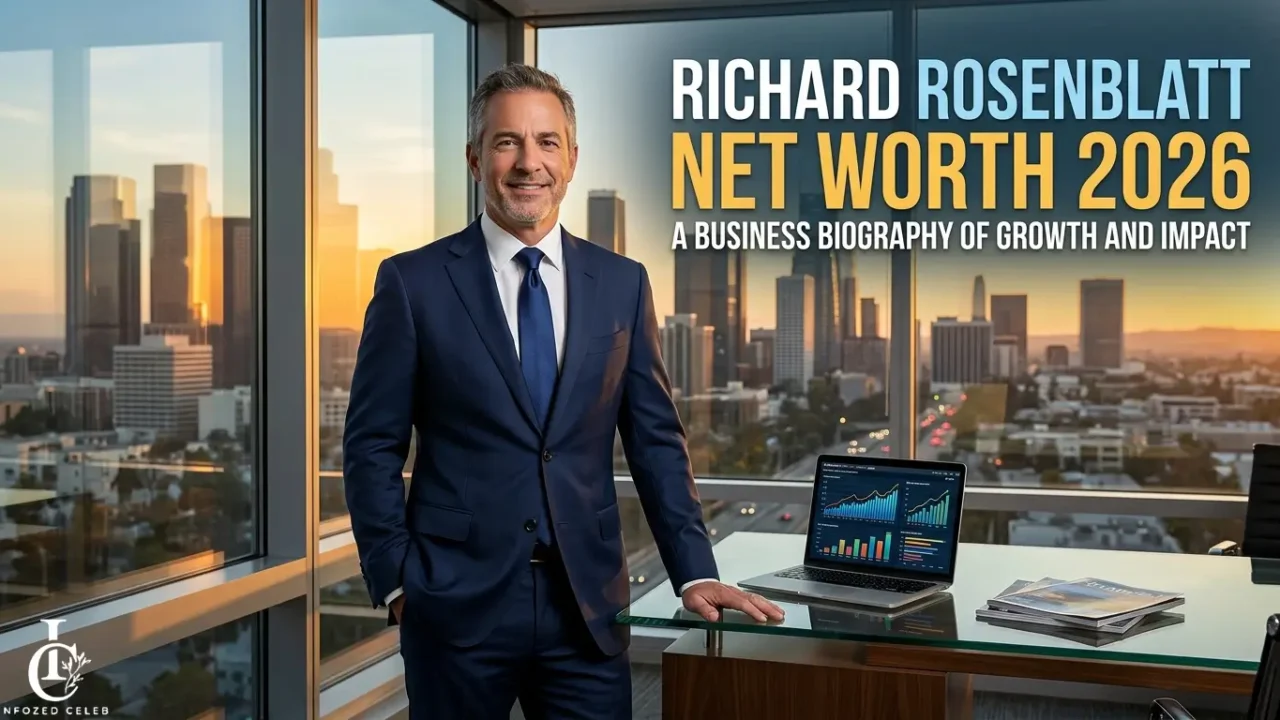
Quick answer: Celebrity Net Worth estimates Richard Rosenblatt at about $150 million, on a profile last updated 14 August 2026. Forbes has no Rosenblatt profile — the URL returns a 404 — so there is no second compiler to check that figure against.
What makes this page worth writing carefully is not the estimate. It is that Rosenblatt’s career produced three enormous, widely quoted numbers — $425 million, $580 million and $1.5 billion — and not one of them is money he received. Two are prices paid for companies he ran. One is a stock market’s opinion of a company on a single morning.
His actual documented personal proceeds are much smaller, much more interesting, and available in primary sources. Securities filings show him receiving $23,046,000 when News Corporation bought Intermix Media, and selling 664,981 shares for roughly $11.3 million in the Demand Media flotation. Those are the real numbers, and this page shows the filings they come from.
For the buyer’s side of the MySpace story, see James Murdoch’s net worth — the acquirer was his father’s company. For the same paper-versus-realised distinction on a far larger scale, see Elon Musk’s net worth, and for another founder who sold his company, Ryan Smith’s net worth.
Quick facts
| Item | Named record |
|---|---|
| Celebrity Net Worth | About $150 million (profile last updated 14 August 2026) |
| Forbes | No profile. forbes.com/profile/richard-rosenblatt/ returns 404 |
| Born | 6 April 1969; grew up in California’s San Fernando Valley |
| Education | BA in political science, UCLA; Juris Doctor, USC Law School |
| iMall sale, 1999 | About $425 million, paid entirely in Excite@Home stock. The buyer filed for bankruptcy in 2001 |
| Intermix / MySpace sale, 2005 | $580 million to News Corporation, at $12 a share. Rosenblatt’s share: $23,046,000, per SEC filings |
| Demand Media IPO, 2011 | Sold 664,981 shares for about $11.3 million; kept 6,116,076 worth about $104 million on paper |
| Property | Paid about $26 million for a Brentwood estate in February 2011 |
| Now | Chairman of Future; a Lionsgate director since May 2025 |
Three numbers that were never his
Almost every profile of Rosenblatt repeats the same three figures as though they were personal earnings. Here is what each one actually measures.
| The quoted number | What it really is | What he actually got |
|---|---|---|
| iMall, 1999 | A price for the whole company, paid in the buyer’s shares | A stake in a company that went bankrupt two years later |
| Intermix, 2005 | $580 million paid by News Corporation for the company, at $12 a share | $23,046,000 in cash consideration |
| Demand Media, 2011 | A market capitalisation: a share price multiplied by a share count | $11.3 million realised in the offering |
None of this diminishes what he built. It just means the widely quoted figures answer a different question from the one a net-worth page is asking.
iMall, 1999: $425 million, paid in a currency that collapsed
The live version of this page said Rosenblatt sold iMall for $565 million and called it his first huge success. The primary document says otherwise, and the difference matters twice over.
Rosenblatt co-founded iMall in 1994 to help small and midsized merchants sell online, and became its chief executive and chairman. On 12 July 1999, At Home Corporation — trading as Excite@Home — agreed to buy it. The Form 8-K filed with the SEC sets out the terms plainly: Excite@Home would issue approximately 8.3 million shares of its stock, having a value of approximately $425 million, and assume iMall’s outstanding options. Each iMall shareholder would receive 0.46 Excite@Home shares per iMall share. The New York Times reported it the next day under the headline that it was a $425 million deal in stock, valuing iMall’s shares at $23.69 based on the previous close.
So the first correction is arithmetic: the announced figure was about $425 million, not $565 million.
The second correction is more important. This was an all-stock transaction. Nobody handed over $425 million in cash. iMall’s shareholders received paper in Excite@Home, and the value of that paper was whatever the market said it was on any given day. The same 8-K records that Rosenblatt was one of several holders: he, First Data and certain other iMall shareholders collectively held over 40% of the company and agreed to vote for the deal. He was not selling a company he owned outright.
Then came the part the old page omitted entirely. Rosenblatt stayed on, running Excite@Home’s E-Business Services group. And on 28 September 2001, Excite@Home filed for bankruptcy protection, agreeing to sell its broadband business to AT&T for $307 million in cash. The Associated Press report notes the company had lost $7.4 billion, and that the 1999 merger which created it had been a $6.7 billion deal.
A sale price denominated in the buyer’s stock is only worth what you can sell that stock for. We have no public record of when or whether Rosenblatt sold his Excite@Home shares, so this page does not guess at what he cleared. What can be said is that quoting a 1999 all-stock headline figure as though it were cash in his pocket ignores the bankruptcy that followed in 2001.
MySpace, 2005: the $580 million was the company’s price. His was $23,046,000
In 2004 Rosenblatt became chief executive of Intermix Media, formerly eUniverse, a company founded by Brad Greenspan. Among its properties was a fast-growing social network called MySpace, built by a team including Chris DeWolfe and Tom Anderson. Rosenblatt became chairman of MySpace and ran the parent company as the site became one of the most visited in the United States.
In July 2005, News Corporation agreed to buy Intermix for approximately $580 million in cash, which worked out at $12 a share. The deal closed that September.
That $580 million is the price of a company. What Rosenblatt personally received is itemised, to the dollar, in a proxy supplement filed with the SEC, which set out the cash consideration directors would receive for their shares and options.
| Cash to be received in connection with the merger, in exchange for: | Amount |
|---|---|
| Shares currently owned | $2,706,000 |
| Options that will vest prior to 30 September 2005 anyway | $10,932,750 |
| Options that will vest as a result of the merger | $9,407,250 |
| Total | $23,046,000 |
Read the composition, because it changes the story. Only $2,706,000 of that total — under 12% — was payment for shares Rosenblatt actually owned. Roughly $10.9 million was for options that were going to vest regardless. And about $9.4 million was for options that vested because the merger happened, which is to say a payment triggered by selling the company.
That is a transaction payout to an executive, not a founder’s share of a sale. The same filing shows president Brett Brewer receiving $11,071,250 on the same basis, and other directors far less: David Carlick $1,099,800, Daniel Mosher $1,635,800. If you want a single figure for what MySpace made Rosenblatt, $23 million is the right one, and the $580 million is not a bigger version of it.
The lawsuits the old version of this page left out
You cannot explain how Rosenblatt made his money without mentioning that the largest of those transactions was litigated for years, partly over the very payment described above. These are allegations and we report them as such, along with what the defendants said.
Brad Greenspan, Intermix’s founder and its largest shareholder with close to 4 million shares, about 11% of the company, argued publicly that MySpace was being sold far too cheaply and that management was being paid too much to sell it. The Los Angeles Business Journal quoted him pointing directly at the filings: Rosenblatt “was promised more than $23 million in stock options for closing the News Corp. deal,” while Brewer was granted $11 million. “This is not just a normal bonus for selling the company,” Greenspan said. “It’s a huge lottery win for management and insiders.” He assembled a counter-offer of $13.50 a share, which the company rejected as “speculative and incomplete,” though he did succeed in delaying the shareholder vote by two days.
Two shareholder class actions were filed in the California Superior Court in Los Angeles, on 26 and 31 August 2005, naming the company, Rosenblatt as chief executive, the rest of the board, and venture funds affiliated with VantagePoint Venture Partners holding about 21.5% of the voting power. They alleged breach of fiduciary duty in pursuing the News Corporation acquisition. Intermix told its own shareholders, in the same filing that disclosed the $23,046,000, that “each of the defendants believes that the class action lawsuits are without merit.”
The federal case outlasted the deal by years. In August 2008, a US District Judge in Los Angeles ruled that former Intermix executives including Rosenblatt must face claims they misled shareholders by selling the site for far too little. Reporting on the case in 2010, the New York Times described testimony and documents indicating that Viacom had been excluded from the bidding process and never had the chance to top the News Corporation offer.
Separately, in April 2005 the New York Attorney General opened an investigation into alleged spyware distributed through Intermix’s sites. The company settled for $7.5 million without admitting guilt. Its share price halved to around $4 during the episode before recovering — worth knowing, because the company was sold at $12 a share a few months later.
Demand Media, 2011: $11.3 million realised, $104 million on paper
In 2006 Rosenblatt co-founded Demand Media with the private-equity executive Shawn Colo. It bought eHow and the domain registrar eNom, developed Livestrong.com in partnership with the foundation established by Lance Armstrong, and built a system that read search queries and advertising rates to decide what articles and videos to commission from thousands of freelancers. It worked commercially and drew heavy criticism; the phrase used against it was “content farm.”
Demand Media floated on the New York Stock Exchange in January 2011 at $17 a share, above its indicated $14 to $16 range. The offering closed at 10,235,000 shares, of which the company sold 5,175,000 and existing shareholders sold 5,060,000; Demand Media’s own net proceeds were about $77.2 million, and it received none of the money from the selling shareholders. The stock rose 33% on its first day, closing at $22.65 after touching $25. CNNMoney reported the flotation as valuing Demand at more than $1 billion; Celebrity Net Worth puts the valuation at roughly $1.5 billion. Both are describing the same thing — a share price multiplied by a share count — and the company had 82,680,486 shares outstanding after the offering.
Rosenblatt’s own position is in the registration statement, in the table of selling stockholders.
| Richard M. Rosenblatt | Shares | Value at the $17 offer price |
|---|---|---|
| Beneficially owned before the offering | 6,781,057 | — |
| Sold in the offering | 664,981 | About $11.3 million |
| Retained afterwards | 6,116,076 | About $104 million on paper |
The distinction between those last two rows is the single most useful thing on this page. The $11.3 million was real: shares sold, cash received, at a known price on a known day. The $104 million was an unrealised valuation of shares he still held — a number that existed only while the market agreed to it.
The market stopped agreeing. Demand Media’s shares fell heavily as its traffic growth slowed and changes to Google’s search algorithm hit parts of its publishing business. His holding fell in value with it. He did sell portions over the following years and received further equity awards during his tenure, none of which is publicly totalled. He stepped down as chairman in October 2013 and resigned as chief executive later the same month. The company was eventually renamed Leaf Group.
This is exactly why a stake valued at the market close is not a bank balance, and why this site treats mark-to-market figures as a separate category from money received.
Property, with the prices he actually paid
Celebrity Net Worth records three Southern California transactions with dates and prices, and those are the numbers this page leads with.
| Property | Bought | Sold |
|---|---|---|
| Brentwood Country Estates, Los Angeles — Tuscan-style, four-plus acres, about 21,500 sq ft | About $26 million, February 2011 | Still owned |
| Pacific Palisades — custom-built, more than 7,000 sq ft | About $1.15 million, 1998 | $6.1 million, September 2014 |
| Lake Arrowhead — lakefront, about 5,200 sq ft, with a boat slip | $1.35 million, 2001 | $1.6 million, 2012 |
Note the Lake Arrowhead result specifically: bought for $1.35 million in 2001, sold for $1.6 million in 2012. That is a $250,000 difference before transaction costs, across eleven years. We point it out because property lines on net-worth pages are usually presented as assets that only grow, and on this particular house, over that particular stretch, the two dated prices say otherwise.
Now the figure that needs separating out, because two different $50 million numbers sit next to each other in the source and are easy to merge by accident. Rosenblatt’s Brentwood estate was bought next door to the enormous house then being built by Tom Brady and Gisele Bündchen — a house eventually bought by Dr. Dre for $50 million. That $50 million is a real, completed sale, and it is not Rosenblatt’s house. Separately, Celebrity Net Worth notes that “recent automated estimates” put the value of Rosenblatt’s own property at around $50 million, while cautioning that “its actual market value could differ substantially.”
An automated estimate is an algorithm’s guess from comparable sales, of the kind property portals generate for every address in the country. It is not an appraisal, not an offer and not a transaction. The previous version of this page printed it as “recent estimates say the property might be worth around $50 million” and left readers to assume a valuation had taken place. The defensible figure for this house is the $26 million he paid for it in February 2011. Source descriptions of the house also disagree on its size: the profile lists eight bedrooms and 13 bathrooms, while noting that contemporary reports described ten bedrooms.
What he is doing now
Rosenblatt returned to founding companies in 2014 with Whipclip, a platform for legally sharing television clips. It acquired TVShow Time, which became TV Time, then combined with the entertainment-data company Mediamorph to form Whip Media Group, selling data and software to entertainment companies. Per Lionsgate’s own investor-relations biography he was its chair and chief executive from January 2014 to October 2023.
In February 2021 he co-founded Autograph with Tom Brady as co-chairman, initially built around digital collectibles and athlete-led fan experiences. It raised substantial venture funding and moved beyond its original NFT focus. In January 2025 Autograph merged with Future, a digital personal-training company, and Rosenblatt became chairman of the combined business, which now concentrates on technology-assisted fitness and longevity. In December 2021 he also co-founded and chaired Adim, a Web3 platform connecting premium content to creators, with Robert McElhenney; it has since been renamed INCENTION.
On the governance side, he served on the board of DraftKings from April 2020 to April 2021, and on its predecessor company’s board from January 2018, and remains a senior adviser to DraftKings and to Fifth Down Capital. He sits on the board of Imagine Entertainment, the production company co-founded by Ron Howard and Brian Grazer. He has been a director of Lionsgate since May 2025, serving on its Nominating and Corporate Governance Committee and its Transaction Committee.
Fortune has named him one of “The 50 Smartest People in Tech,” the Los Angeles Business Journal named him one of its “Most Admired CEOs,” and in 2016 he was inducted into the USC Marshall School of Business Entrepreneurs Hall of Fame. He is married to Lisa Rosenblatt.
Career timeline
| Year | Event |
|---|---|
| 1969 | Born 6 April in California |
| 1994 | Co-founds iMall; later becomes its chief executive and chairman |
| 1999 | Excite@Home agrees to acquire iMall for about $425 million in stock |
| 2000 | Becomes chief executive of DrKoop.com, which files for bankruptcy in 2001 |
| 2001 | Excite@Home files for bankruptcy protection |
| 2004 | Becomes chief executive of Intermix Media and chairman of MySpace |
| 2005 | News Corporation buys Intermix for $580 million; Rosenblatt receives $23,046,000 |
| 2006 | Co-founds Demand Media with Shawn Colo |
| 2011 | Demand Media floats at $17 a share; he sells 664,981 shares and keeps 6,116,076 |
| 2013 | Steps down as chairman and resigns as chief executive of Demand Media in October |
| 2014 | Launches Whipclip, which becomes Whip Media Group; chair and CEO until October 2023 |
| 2021 | Co-founds Autograph with Tom Brady in February, and Adim in December |
| 2025 | Autograph merges with Future in January; joins the Lionsgate board in May |
How we research this page
Three primary documents do most of the work here. At Home Corporation’s 1999 Form 8-K for the iMall terms, including the all-stock structure and the over-40% shareholder bloc. Intermix Media’s 2005 proxy supplement for the itemised $23,046,000, which is why this page can break that figure into owned shares, options vesting anyway and options accelerated by the merger rather than quoting a round number. And Demand Media’s registration statement for the selling-stockholder table giving 6,781,057 shares held, 664,981 sold and 6,116,076 retained. Celebrity Net Worth supplies the $150 million estimate and the property transactions, dated to its 14 August 2026 update. The Los Angeles Times covers the Excite@Home bankruptcy in 2001 and the 2008 ruling on the shareholder claims; the Los Angeles Business Journal covers Greenspan’s objections at the time. Forbes was checked directly and has no profile. Several sources are named but not linked because they block automated requests: the New York Times on the 1999 deal and the 2010 litigation, CNNMoney on the flotation’s first day, Leaf Group’s own press release announcing the closing of the offering, and Lionsgate’s investor-relations biography, which is the source for the board dates and awards. Allegations are reported as allegations, with the defendants’ response included. Process: About Us.
Frequently asked questions
What is Richard Rosenblatt’s net worth in 2026?
Celebrity Net Worth estimates about $150 million, on a profile last updated on 14 August 2026. That is the only estimate from a named compiler, because Forbes does not publish a Rosenblatt profile at all. Treat it as one organisation’s estimate rather than a measured figure, and note that the large numbers usually attached to his name are company sale prices and market valuations, not personal wealth.
How much did Richard Rosenblatt make from MySpace?
According to Intermix Media’s own proxy supplement filed with the SEC, he received $23,046,000 in cash consideration when News Corporation bought the company. The filing itemises it: $2,706,000 for shares he already owned, $10,932,750 for options that would have vested before 30 September 2005 anyway, and $9,407,250 for options that vested as a direct result of the merger. The often-quoted $580 million was the price News Corporation paid for the whole company, at $12 a share, not a payment to him.
Did Richard Rosenblatt sell iMall for $565 million?
No. The Form 8-K filed with the SEC in July 1999 states that Excite@Home would issue approximately 8.3 million of its own shares, having a value of approximately $425 million, at a ratio of 0.46 Excite@Home shares for each iMall share. It was an all-stock deal rather than a cash one, and the same filing shows Rosenblatt was one of several holders who together held more than 40% of iMall, not its sole owner. Excite@Home then filed for bankruptcy protection in September 2001 after losses of $7.4 billion, so the value of stock received in that deal depended entirely on when it was sold.
How much did the Demand Media IPO pay him?
The registration statement shows he beneficially owned 6,781,057 shares before the offering and sold 664,981 of them, which at the $17 offer price is about $11.3 million. He retained 6,116,076 shares, worth roughly $104 million at that same price, but that was an unrealised paper value rather than money received. The shares later fell substantially as Google search algorithm changes hurt the company’s traffic, and he resigned as chairman and chief executive in October 2013.
Is Richard Rosenblatt’s house worth $50 million?
Nobody has established that. He paid about $26 million for the Brentwood Country Estates property in February 2011, and that purchase price is the only firm figure. The $50 million comes from what Celebrity Net Worth describes as recent automated estimates, which are algorithmic guesses from comparable sales rather than appraisals, and the same profile cautions that the actual market value could differ substantially. Confusing matters further, a separate and genuine $50 million sale happened next door: that was the price Dr. Dre paid for the house built by Tom Brady and Gisele Bundchen, not Rosenblatt’s home.
What does Richard Rosenblatt do now?
He is chairman of Future, the fitness and longevity business created when Autograph, which he co-founded with Tom Brady in February 2021, merged with the digital personal-training company Future in January 2025. He has been a director of Lionsgate since May 2025, sits on the board of Imagine Entertainment, and is a senior adviser to DraftKings and Fifth Down Capital. He was chair and chief executive of Whip Media Group from January 2014 until October 2023.
Bottom line
Richard Rosenblatt is a genuinely consequential internet operator whose money is routinely described using numbers that were never his. Celebrity Net Worth estimates $150 million, updated 14 August 2026, and Forbes offers nothing to check it against. Against that single estimate sit two documented personal figures, both from filings anyone can read: $23,046,000 from the Intermix sale, of which under 12% was payment for shares he owned and roughly 41% was options that vested because the deal closed, and about $11.3 million realised from selling 664,981 Demand Media shares at $17. The $425 million iMall headline was paid in the stock of a company that went bankrupt two years later. The $1.5 billion was a market capitalisation. The $104 million was a paper valuation that the market subsequently withdrew. And the $50 million attached to his house is an algorithm’s guess sitting beside a real $50 million sale of somebody else’s home. The useful question about any figure on a page like this is never how large it is. It is who received it, in what, and on what date.